In 1997, four names that came from nowhere became familiar to millions of children: Tinky Winky, Dipsy, Laa-Laa, and Po. No nod to pop culture, no hidden tribute to a traditional name, just invented syllables that fit the ears and mouths of the youngest. The creators of the Teletubbies have never officially explained the exact meaning of the names Tinky Winky, Dipsy, Laa-Laa, and Po. However, each name results from a series of linguistic choices aimed at phonetic simplicity, suitable for early childhood. Unlike other children’s series, there are no references to popular culture, existing names, or common words hidden behind these appellations.
The selection of names reflects a desire to stimulate memorization and pronunciation in toddlers, while clearly differentiating each character. This choice marks a break from the usual conventions of the audiovisual sector for youth.
Who are Tinky Winky, Dipsy, Laa-Laa, and Po really? Portraits and characteristics of the Teletubbies
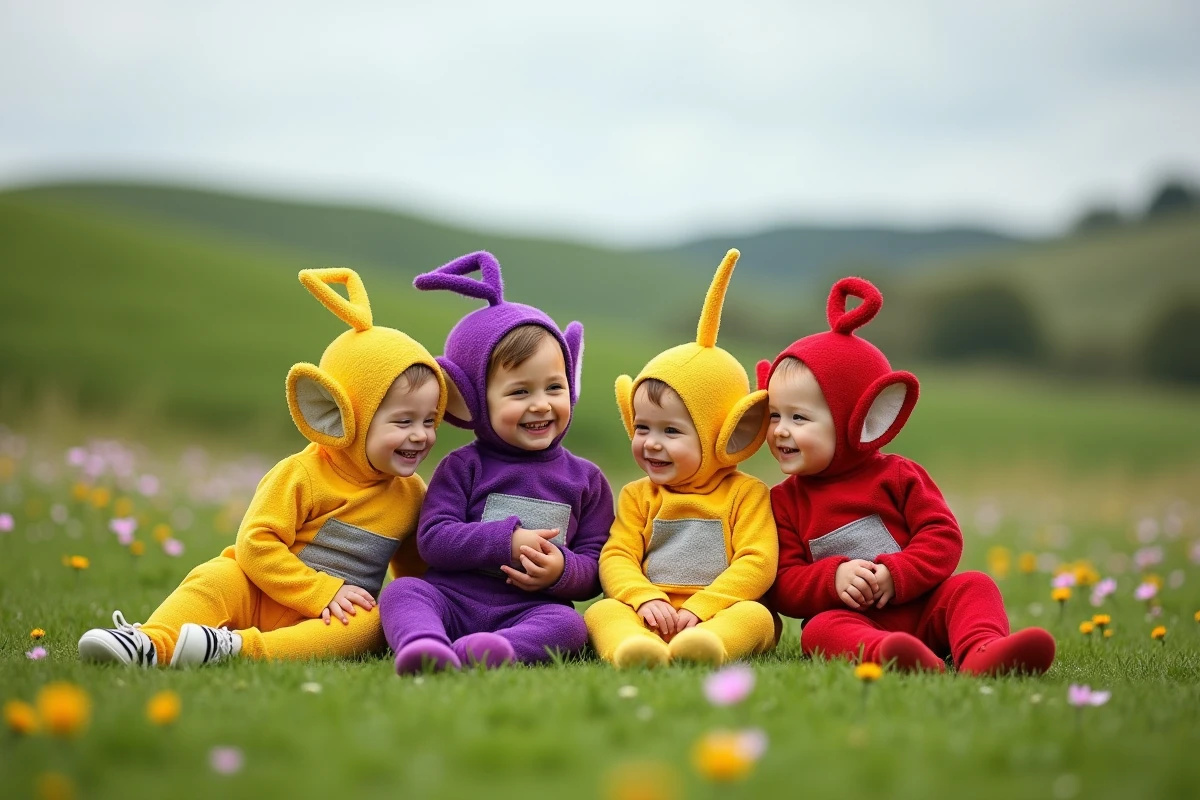
In the world of the Teletubbies, the group is recognizable among all. Four colorful characters: Tinky Winky, dressed in purple with his triangular antenna and handbag, dominates with his stature. His reassuring presence imposes a sense of calm within the quartet. Dipsy, dressed entirely in green, stands out with his hat and straight antenna, an eccentric and deliberately offbeat silhouette, with a floating and unpredictable energy. Both embody the male figure of the group, but they still share distinctly different temperaments.
Alongside them, Laa-Laa brings a sunny light, dressed in yellow, inseparable from her red ball and looped antenna. Her dynamism and contagious joy find a counterpoint in Po, the smallest, dressed in red, with a scooter in hand and a circular antenna on her head. Po, mischievous and lively, entertains with her fearless character. This distribution of colors, accessories, bag, hat, ball, scooter, and the variation of antennas creates a gallery of immediately identifiable profiles for children. Not to mention the face of the famous Baby Sun (Jess Smith), who watches over their adventures.
Nothing is left to chance: colors, objects, gender… Everything contributes to shaping clear identities that are easy to distinguish and memorize from a very young age. To understand the logic behind these fictional names, one only needs to consult the names of the Teletubbies and their origin. This journey sheds light on the desire to offer accessible musicality to all, breaking with the tradition of child heroes named after classic names.
The origin of the Teletubbies’ names: revelations and unexpected inspirations
At the genesis of the Teletubbies’ names, there is a clear intention: to invent soft, easy, universal sounds. Anne Wood and Andrew Davenport, the minds behind the series, spent time testing combinations of syllables. They sought musicality, simplicity, and obviousness. The result: names that seem to flow naturally, that repeat like a nursery rhyme, and that are effortlessly remembered all over the world.
The names Tinky Winky, Dipsy, Laa-Laa, and Po rely on sound structures close to the babbling of toddlers. No hidden allusion, no nod to existing names. The syllables snap, stretch, and bounce. Laa-Laa plays on repetition, Po on brevity, Tinky Winky and Dipsy on a musicality that catches children’s ears. Everything has been designed so that, from the opening credits, the child recognizes and claims each character, long before understanding anything about the story.
Surprising anecdotes and behind-the-scenes secrets about the cult characters
The birth of the Teletubbies is not a matter of chance. On March 31, 1997, the BBC aired the first episodes of the series created by Anne Wood and Andrew Davenport. From the start, the directive was clear: create a universe disconnected from time and space, without specific geographical references, so that children around the world could relate to it.
Quickly, the series transcended British borders. In France, Canal+ and then Canal J seized the phenomenon. In China, Youku broadcasts the colorful adventures of the four friends. More recently, the 2022 reboot on Netflix (narrated by Titus Burgess) reminds us how the Teletubbies universe adapts to all eras and audiences. This global success is accompanied by an infinite array of merchandise: video games, TubbyDelice, TubbiToasts… the brand makes its way into living rooms, snack times, and supermarket shelves.
Behind the scenes, however, tells another story. The costumes of the actors, John Simmit, Nikky Smedley, Simon Shelton, and Pui Fan Lee, are heavy, limiting vision and mobility. On set, the heat quickly becomes stifling. The performers then develop a gestural language, away from the cameras, to coordinate without a word. As for the famous baby sun, its face, that of Jess Smith, a baby with a bright smile, has become an iconic image, far beyond what the main interested party could have imagined.
The Teletubbies have conquered the planet thanks to this palette of colors, their unique objects, and their invented language. More than just a children’s program, they have become a generational landmark, transcending years, languages, and borders. Their names resonate like a refrain that does not fade away.